The numbers are getting difficult to ignore.
Morgan Stanley forecasts cited by The Wall Street Journal put global demand for data-center capacity at roughly 56 GW in 2027, against 51 GW of new facilities coming online. By 2028, those figures rise to 86 GW and 68 GW respectively, a projected gap of 18 GW.
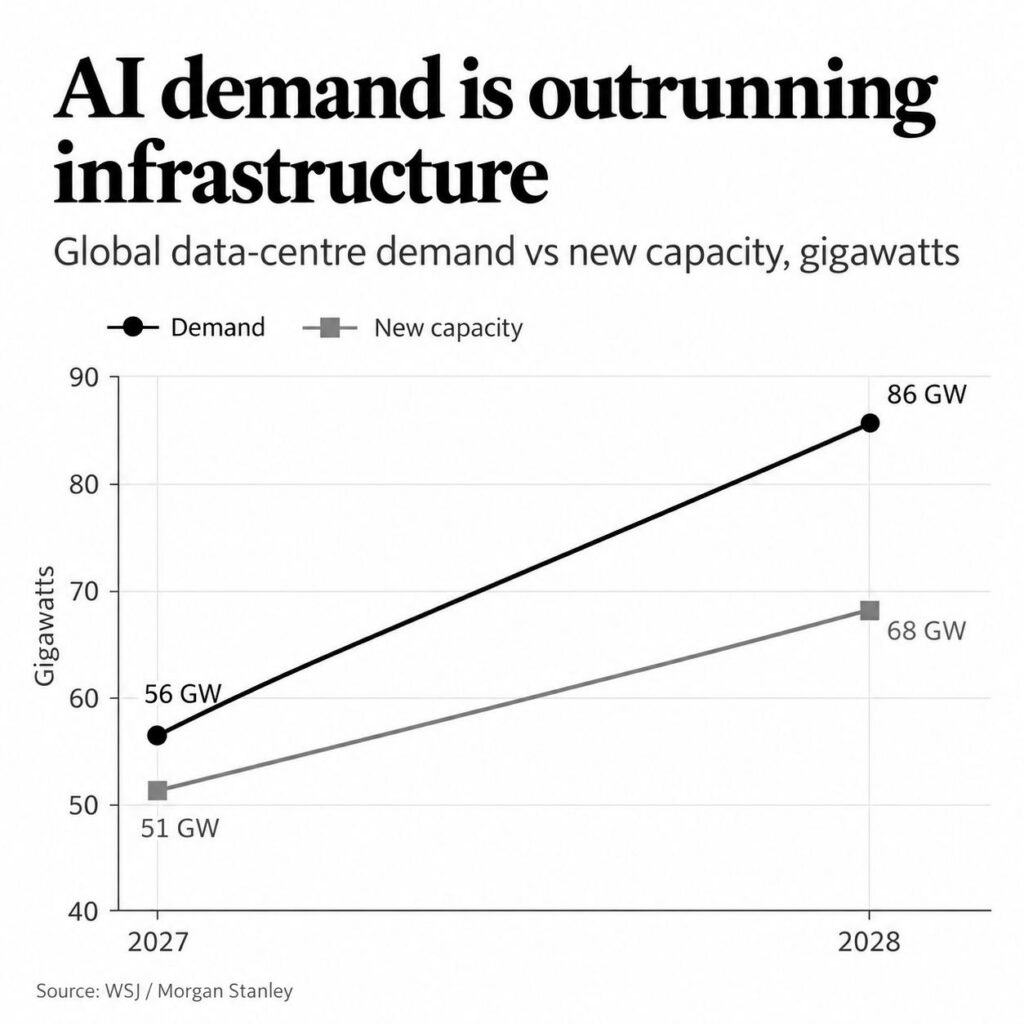
That is where the economics become interesting.
AI demand, capital and model development are moving extremely fast. Power generation, grids, permitting and construction move in years. Chips are improving. Efficiency is improving too. But these curves are not moving together.
We have seen this pattern in oil, shipping and semiconductors. When supply chains tighten, the economics migrate toward the bottleneck. Refining capacity can matter more than crude supply. Port capacity can matter more than the number of ships. Fab capacity can determine the economics of entire industries.
For AI, that bottleneck is increasingly usable compute: chips, power, cooling, grid access and data-center capacity, working together.
Owning chips is only part of the equation. They need somewhere to run, electricity to power them and cooling to keep them operational. An announced project is not the same as capacity available to serve customers.
Another number worth watching: one estimate discussed in The Wall Street Journal suggests that, by 2032, annual US spending on AI services would need to rival spending on food to justify the capital being deployed. That is a demanding assumption about future revenues.
It creates a fascinating setup for the next generation of AI companies entering public markets. Investors will have to assess compute intensity, access to capacity, capital requirements and margin resilience alongside revenue growth.
For the people running businesses, the questions are equally practical. How dependable is your provider’s capacity? What happens to your economics if usage grows faster than expected? Can the productivity gains justify the full cost of delivery?
A supply squeeze can reward whoever controls scarce capacity. But those advantages can change as new supply arrives, efficiency improves and prices adjust. The timing matters as much as the technology.
The company with the best model does not automatically capture the best economics.
My view: the next phase of AI will reward those who control, or remove the bottleneck.
Sources:
A Data-Center Crunch Is Coming — The Wall Street Journal
Will America Spend 9% of Its GDP on AI? The Industry Is Counting on It — The Wall Street Journal