Why the path from technological capability to economic transformation may be far more complicated than current AI valuations suggest
The extraordinary valuations being assigned to frontier AI companies reflect an equally extraordinary set of expectations about the future of work. Much of the economic argument depends on the assumption that advances in artificial intelligence will translate rapidly into productivity gains, lower operating costs and, eventually, the replacement of substantial portions of human labour.
There is little reason to doubt that AI will transform large parts of the economy. Its capabilities are advancing rapidly, the investment behind it is substantial, and businesses are already finding practical applications across software development, customer operations, research and administrative work.
What deserves closer examination is the speed and scale at which these advances can become economic value.
Technology is only one variable in that equation. Organisations have their own internal logic, societies have limits to the pace of change they can absorb, and institutions rarely adapt at the speed imagined by those developing the technologies that challenge them.
The history of technological change offers plenty of evidence that invention and economic transformation operate on different timelines.
The knowledge economy is more complicated than its job descriptions
A considerable part of the discussion around AI-driven employment displacement begins by breaking occupations into tasks and estimating how many of those tasks could be automated.
It is a useful analytical approach, but one that can easily lead to exaggerated conclusions when extended to entire professions.
Consider a senior relationship manager at a financial institution. AI may be capable of preparing client briefs, analysing financial statements, identifying commercial opportunities and drafting sophisticated recommendations. These activities account for a meaningful portion of the role.
Yet the economic value of that individual is not limited to the production of information.
It also depends on years of accumulated relationships, an understanding of institutional sensitivities, the ability to negotiate competing interests and the judgement to recognise when the formally correct answer is commercially unacceptable.
The same applies to a project director navigating a failing transformation programme, a lawyer managing an unpredictable negotiation or a consultant trying to build consensus among executives whose incentives are fundamentally misaligned.
Much of this work relies on tacit knowledge: the kind of understanding that develops through experience, observation and relationships, and which organisations often struggle to document even for their own employees.
AI will undoubtedly become better at supporting these activities, and some of them will eventually be handled autonomously. But measuring the technical automation potential of individual tasks does not establish that the economic function of the person performing them can be eliminated at the same rate.
The International Labour Organization’s 2025 assessment provides useful perspective. It estimates that approximately one quarter of global employment is exposed to generative AI to some degree, while concluding that transformation of jobs is more likely than their outright disappearance.
This distinction matters enormously when the anticipated economic return from AI depends on substantial labour displacement.
Productivity gains are not the same as economic transformation
The evidence emerging from workplace deployments is encouraging, although less conclusive than the prevailing investment narrative might suggest.
A field experiment involving 7,137 knowledge workers across 66 firms examined the impact of providing access to generative AI within existing workplace applications.
Among participants who actively used the technology, researchers observed a reduction of approximately two hours per week spent on email. They also identified reductions in work performed outside regular working hours.
These are useful gains. Anyone managing a large organisation would recognise their value.
What the researchers did not detect was a corresponding change in the overall quantity or composition of workers’ tasks resulting from individual access to AI.
The finding illustrates an important economic distinction.
An employee recovering two hours each week does not automatically translate into a proportional reduction in payroll costs. Those hours may be absorbed by additional meetings, client interaction, existing backlogs or simply a less demanding working week.
In some organisations, the benefit will come through improved service quality or greater capacity. Others may eventually redesign roles and reduce headcount. The outcome depends on management decisions, operational constraints and the organisation’s ability to convert released capacity into measurable financial results.
McKinsey’s November 2025 global AI survey reinforces this uneven picture. Nearly nine in ten respondents reported regular AI use within their organisations, yet only 39% reported an impact on enterprise-level earnings before interest and taxes (EBIT). Nearly two-thirds had not begun scaling AI across the enterprise.
The distinction between adoption and economic return is particularly important for investors. Rapid growth in AI usage establishes demand for the technology, but it does not establish how much additional profit businesses will ultimately generate from it, or how much of that profit AI providers will be able to capture.
Understanding change through the Futures Triangle
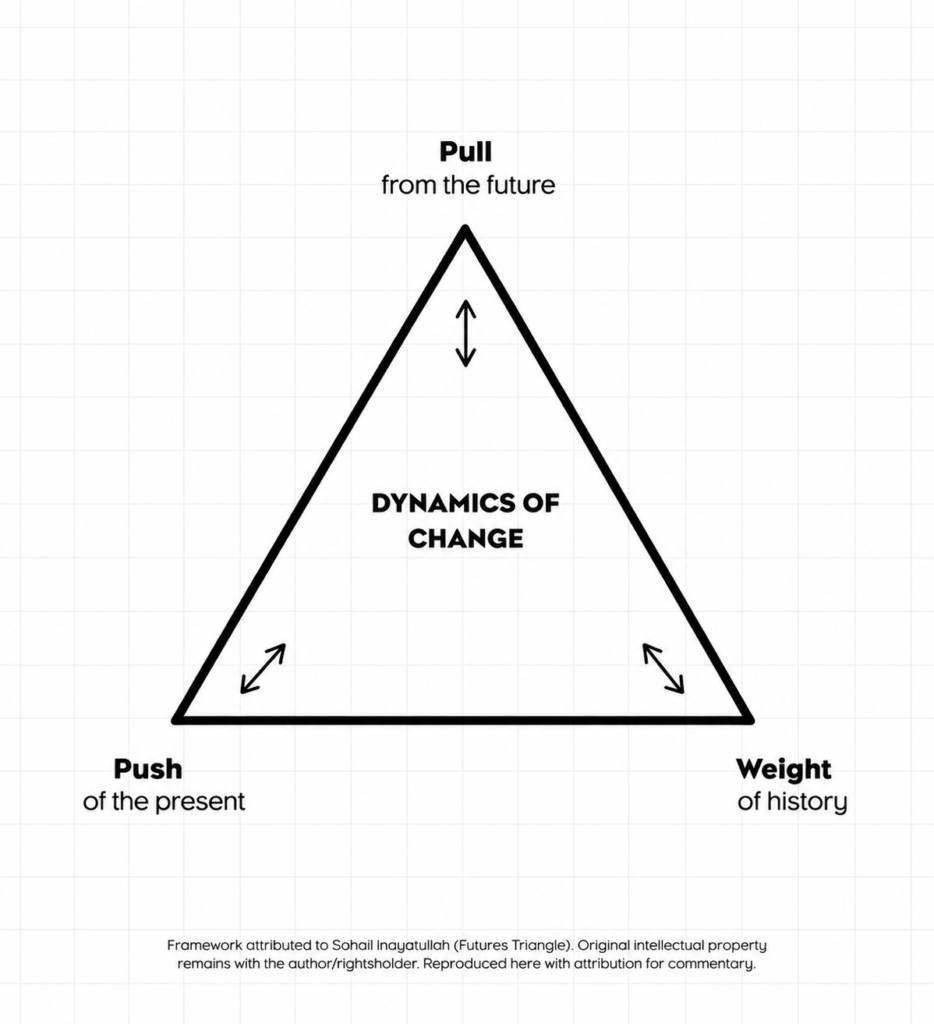
The difficulty of translating technological capability into broad economic transformation becomes clearer when viewed through the Futures Triangle, a framework developed by futurist Sohail Inayatullah.
The framework examines the interaction of three forces: the pull of the future, the push of the present and the weight of history.
Applied to artificial intelligence, it helps explain why a technologically plausible future may still encounter substantial resistance on its way to becoming an economic reality.
The pull of the future is the increasingly persuasive vision of organisations operating with far fewer people, supported by autonomous systems capable of executing complex processes at a fraction of today’s cost.
This vision is already influencing investment decisions, corporate strategies and expectations of future profitability. It is also central to the case for large-scale investment in the infrastructure and companies supporting frontier AI.
The push of the present comes from the powerful economic incentives encouraging adoption. Businesses face pressure to improve margins, raise productivity, address skills shortages and compete with organisations experimenting with new operating models.
These incentives are real. They explain why AI deployment is unlikely to slow simply because its implementation is difficult.
The weight of history is where the transformation becomes considerably less predictable.
Established businesses carry decades of accumulated organisational structures, regulatory obligations, employment practices, legacy systems and relationships. Many of these arrangements are inefficient, but they exist for reasons that go beyond the immediate cost of performing a task.
Banks cannot simply remove controls because AI can execute a process faster. Governments cannot restructure employment protections overnight. Organisations cannot assume that customers, employees or regulators will automatically accept a system merely because its technical performance is impressive.
The resulting future will be shaped by the interaction of all three forces, rather than the technological destination alone.
Three assumptions behind the acceleration scenario
For the most ambitious projections of AI-driven economic transformation to materialise within a compressed timeframe, several conditions must hold simultaneously.
The first concerns institutional adaptability.
Governments and regulators must respond to advances in AI quickly enough to permit widespread deployment while maintaining public confidence and adequate protections. This involves decisions around liability, privacy, competition, employment law and accountability for automated decisions.
Institutions have adapted to technological revolutions before. The difficulty lies in assuming that their pace of adjustment will keep up with the rate of technical progress.
The second concerns social acceptance.
Employment is more than a mechanism for distributing income. It influences personal identity, social stability, public finances and political behaviour. Large-scale displacement of skilled workers would create consequences extending well beyond the immediate economics of the industries involved.
Governments facing sustained employment disruption would have strong incentives to intervene through regulation, taxation, public investment or labour-market protections.
Such intervention could influence the speed, cost and commercial attractiveness of automation.
The third concerns labour-market absorption.
Economic history contains many examples of technological change creating new occupations while making others obsolete. But the transition has rarely been frictionless, and the benefits have not always reached the people or communities bearing the initial costs.
The assumption that displaced knowledge workers can move quickly into new forms of productive employment deserves scrutiny, particularly if disruption occurs simultaneously across multiple sectors and occupational categories.
The question is not whether new work will emerge. It is whether the economy can generate sufficient opportunities, in the appropriate locations and at comparable levels of compensation, within the timeframe implied by the most aggressive AI forecasts.
Each of these conditions introduces uncertainty. Together, they make the pace of transformation much harder to predict.
The valuation question
This uncertainty has direct implications for the economics of frontier AI.
The cost of developing and operating advanced AI systems is already being incurred through capital expenditure, computing infrastructure, energy requirements, specialised talent and ongoing research.
Much of the anticipated financial return, however, remains dependent on future enterprise adoption and the ability of customers to generate substantial economic value from the technology.
If implementation requires longer transformation cycles, extensive human oversight, organisational restructuring or sustained regulatory compliance, the economic benefits may arrive more slowly and at greater cost than some optimistic projections assume.
There is also the question of value distribution.
Even where AI creates substantial productivity gains, there is no guarantee that frontier model developers will capture the majority of that value. Customers, application providers, infrastructure operators and competitive pressures may all influence how the benefits are distributed.
A technology can become essential to the global economy without every company supplying that technology earning returns sufficient to justify its valuation.
This does not establish that frontier AI companies are collectively overvalued. That conclusion would require examining individual firms, their revenues, margins, capital requirements and the expectations reflected in their valuations.
It does, however, suggest that investors should distinguish more carefully between technological potential, economically achievable outcomes and the timing of the financial returns.
The difference between those three can be substantial.
The future is unlikely to arrive evenly
AI will change the economics of knowledge work, but the process will be shaped by institutions, incentives and human behaviour as much as by improvements in model capability.
Some roles will disappear. Others will expand in scope. Entire workflows may eventually operate with minimal human involvement, while apparently simpler activities continue to require supervision, negotiation or direct human accountability.
Different industries, countries and organisations will move at different speeds.
For business leaders, understanding those differences is essential to making sensible investment decisions. For investors, they introduce uncertainty into assumptions about adoption, profitability and the speed at which new markets can develop.
And for policymakers, they raise difficult questions about how societies should distribute the gains and manage the costs of technological progress.
The greatest uncertainty surrounding AI may no longer be whether the technology will become sufficiently capable.
It may be how quickly the economic and social systems surrounding it can accommodate what the technology makes possible.
That is a much less predictable process than the exponential curves used to describe advances in computing power and model performance.
It may also be the most important variable missing from the current AI investment narrative.
Sources and references:
- McKinsey (2025) — The State of AI in 2025: Agents, Innovation, and Transformation.
- National Bureau of Economic Research (2025) — Shifting Work Patterns with Generative AI.
- International Labour Organization (2025) — Generative AI and Jobs: A 2025 Update.
- Sohail Inayatullah (2023) — The Futures Triangle: Origins and Iterations.