Why small and mid-sized businesses need to rethink how work gets done before buying another AI tool?
The most expensive mistake a business can make with AI may be a very ordinary one: keeping everything else the same. The same reporting lines. The same approval chains. The same job descriptions. The same definition of productivity. Only now everyone has a clever assistant and a management dashboard counting how often they use it. That is not transformation. It is the old organisation running a little faster, sometimes in the wrong direction.
For small and mid-sized businesses, this matters more than it might for a multinational. A large corporation can absorb a few failed experiments. A 70-person company cannot casually fund six tools, three disconnected pilots, and another layer of management to reconcile their outputs. It has to decide what kind of business it is becoming. That is why the unfashionable phrase target operating model deserves to be back in the boardroom.
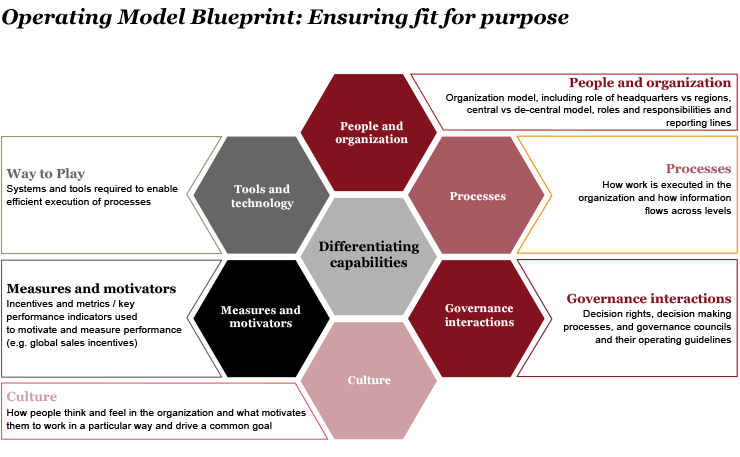
Start with the business you intend to run
A target operating model is not an organisational chart with better typography. It is a set of choices about how the company will create and deliver value: which decisions happen where, what work gets done by people or systems, what data moves between them, who is accountable, and which capabilities the business must own.
Before AI, those choices could be revisited every few years. Now they deserve much more frequent attention. Not a grand restructuring every quarter, but an honest, rolling examination of the assumptions under which the company operates.
Take a mid-sized insurance broker. Its team spends hours gathering documents, comparing policies, producing proposals, and following up with clients. An AI pilot may reduce proposal preparation from four hours to forty minutes. Good. But what happens next? Does the broker win more business? Does advice improve? Can senior advisers spend more time on complex risks? Or does the company simply produce ten times as many proposals that nobody has the capacity to review, explain, or sell?
The bottleneck moves. So does the money.
If drafting becomes nearly free, editing and judgment become scarce. If software is easier to produce, integration, security and verification can become the choke points. If every competitor can generate competent marketing content, earning attention and reaching customers become harder, not easier.
This is a second-order effect that managers underestimate. The cost of one activity collapses, demand for a neighbouring activity rises, and suddenly the scarce capability sits somewhere nobody thought to invest.
It is close to the broader argument that value shifts away from readily available tools and toward distribution: access to customers, trusted relationships, channels, and the ability to turn an output into an outcome. But distribution is only part of it. In some industries the new source of value will be regulatory judgment. In others it will be proprietary data, integration, customer experience, or the ability to coordinate humans and machines without losing control.
There is also a negative carry to transformation. You pay for licences, integration, training, governance, duplicated workflows, and the mistakes made during transition before the full benefits arrive. Worse, a local productivity gain can create a system-wide cost. A sales team that produces twice as many proposals may overwhelm legal or delivery. A support bot that closes simple cases may leave humans with only the most emotionally demanding ones.
The implication is uncomfortable: the to-be organisation may need fewer people in one function and much stronger people in another. The skills plan cannot be an afterthought to the technology plan.
The shift nobody has budgeted for: structural uncertainty
I was struck by a distinction made by Sangeet Paul Choudary in his work on the reshuffling of knowledge work. Most companies are treating AI as an operational uncertainty: the rules remain broadly intact, and the challenge is to perform within them. But AI also creates structural uncertainty: the rules, roles, boundaries and sources of value can themselves change.
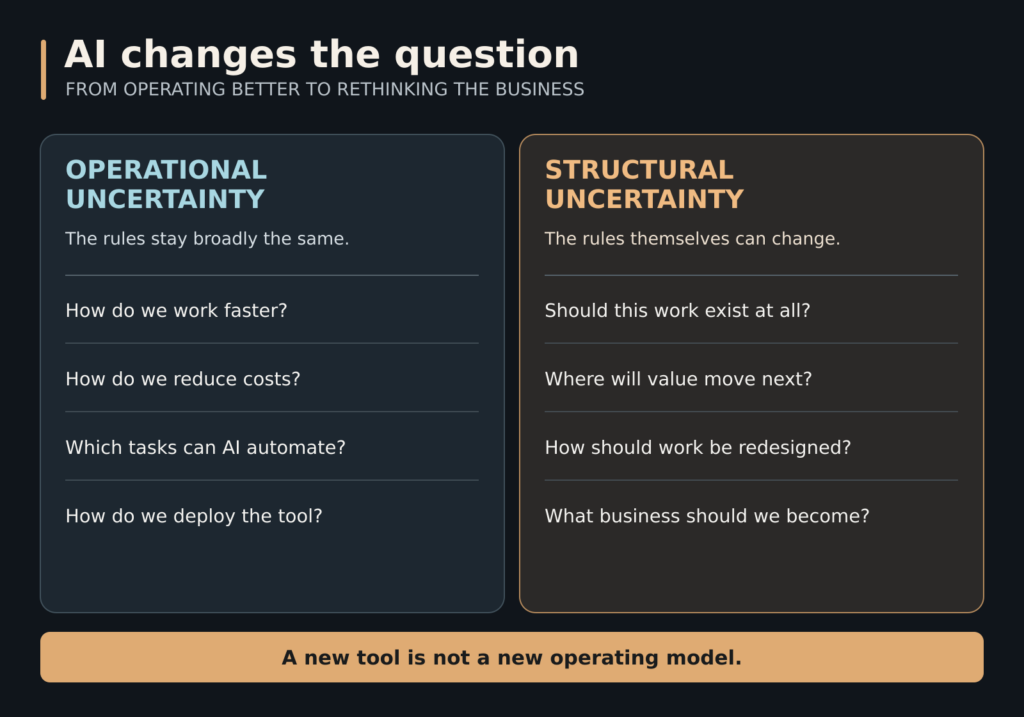
Under operational uncertainty, the manager asks, “How can we process orders faster?” Under structural uncertainty, the owner asks, “If customers can specify and order directly through intelligent systems, what should our sales operation even look like?”
Both questions matter. Only one challenges the inherited design of the business. SMEs should use that distinction to redraw their processes from the customer outcome backwards. Which steps exist because they genuinely create value? Which exist because information used to be expensive, fragmented, or slow? What would we build today if we were starting from scratch with current capabilities?
AI as a teammate, but please keep a human in the loop
The fashionable choices are presented as opposites: replace the human, or give the human a copilot. Neither is much of an operating model. An effective team distributes work according to comparative strengths. AI can search, classify, draft, compare, simulate, and surface patterns at tremendous speed. People still bring context, accountability, commercial judgment, empathy, negotiation, and responsibility for consequences. None of these human capabilities is automatic, and none is guaranteed to remain valuable without deliberate practice.
“Human in the loop” should not mean hiring someone to click approve on a hundred AI-generated decisions. That is theatre. A useful human checkpoint sits where judgment can change the outcome: an unusual customer request, a consequential credit decision, a safety issue, a pricing exception, an ambiguous recommendation. Low-risk, reversible work may need sampling and monitoring rather than individual approval; high-stakes decisions may need evidence, escalation and a named accountable person.
Nor should we pretend AI is a colleague with intentions or responsibility. Teammate is a helpful design metaphor, not a legal or moral fact. Someone still owns the result. The best human-AI teams will preserve a little deliberate friction: a challenge to an assumption, a request for evidence, a second view before an irreversible decision. Remove all friction and you may remove the moments when people notice that the system is wrong.
Stop counting logins and calling it transformation
The adoption dashboard is seductive. Eighty percent of employees activated their AI assistant. Prompt volume doubled. Documents are written faster. A programme director declares success.
Success at what?
In a field experiment involving 7,137 knowledge workers across 66 firms, access to a generative AI tool saved frequent users time on email, but researchers did not detect a shift in the quantity or composition of tasks from individual-level provision alone. Separately, McKinsey’s 2025 survey found workflow redesign particularly associated with business impact from generative AI. Tool access and organisational reinvention are not synonyms.
AI works when the task is suitable, the data and context are sufficient, performance can be measured, failure is tolerable or controlled, and the workflow around the tool changes. It disappoints when those conditions are missing. Its capabilities are jagged: impressive at something subtle, unreliable at something apparently simple. Two people using the same model can have very different results.
In one published study of more than 5,000 customer-support agents, AI assistance improved issues resolved per hour by about 15% on average, with much larger benefits for less-experienced workers and little improvement for the strongest performers. That is not evidence that AI “works” or “doesn’t work” in general. It is evidence that who uses it, for what, and inside which workflow matters.
For an SME, a more honest scorecard would ask:
- Did the end-to-end customer outcome, improve conversion, resolution, retention or quality?
- Did total cost improve after tools, oversight, rework and risk?
- Did the bottleneck move, and did we prepare the next function for it?
- Are people learning to make better decisions, or merely accepting more machine output?
- Could we scale this process without increasing fragility?
Run bounded experiments. Establish a baseline. Compare the whole workflow, not just the automated step. Review failures. Then change the process, decision rights and skills mix before declaring victory.
Jobs will move before the headlines catch up
The blunt prediction that AI will destroy all jobs is too easy. So is the comforting claim that it will simply free everyone for more creative work. Some tasks will disappear. Some jobs will narrow. Others will expand as output becomes cheaper and demand grows. New roles will emerge around integration, data stewardship, model evaluation, workflow design, security and human oversight. The transition will not be painless or evenly shared.
The likely losers are not necessarily the people with the least education. They may be businesses built entirely around charging for repeatable output; middle layers that only relay information; professionals who confuse familiar process with indispensable expertise; and employees denied the chance to acquire new skills.
The likely winners are organisations that own customer access and trust, combine distinctive knowledge with technology, redesign work end to end, and move people toward the next scarce capability before the market forces them to. Experienced specialists can become more valuable as reviewers, designers and decision-makers provided they do more than rubber-stamp machine output. Smaller firms may even have an advantage: fewer layers to unwind, faster feedback, and proximity to the customer. But agility is a choice, not an automatic benefit of being small.
There is a concentration risk, too. If a handful of platforms control models, interfaces and data flows, they may capture an outsized share of the value while SMEs take on the operational risk. Knowing what to own, what to rent, and where to avoid lock-in belongs in the operating-model conversation.
A question for the owner, not the IT manager
Imagine that tomorrow, half of your administrative and analytical work becomes dramatically cheaper. Would your company be fundamentally better? Or would it simply generate more of the same work, faster, until it hits the next wall?
I would put five questions on the next leadership agenda: What customer outcome are we redesigning? Which constraints will AI remove? Where will the next bottleneck appear? Which decisions must remain human-owned? And what capabilities will we need in twelve months that we do not have today?
The companies that win will not necessarily have the most AI tools, the largest budgets, or the loudest announcements. They will be the ones willing to redraw how the business works while competitors are still celebrating how many people have logged in, or how many tokens they have burned in a month. The AI strategy is not the tool rollout. It is the business you are prepared to become.
Further reading
- Sangeet Paul Choudary, Reshuffle; interview in Farsight, No. 18 (the conceptual inspiration for the operational/structural uncertainty distinction).
- Brynjolfsson, Li & Raymond, “Generative AI at Work,” Quarterly Journal of Economics (2025).
- Dillon, Jaffe, Immorlica & Stanton, “Shifting Work Patterns with Generative AI,” NBER (2025).
- McKinsey, “The State of AI: How Organizations Are Rewiring to Capture Value” (2025).